Work & Impact
Trusted reporting. Measurable business outcomes.
Every engagement starts with a business challenge and ends with reporting leadership can trust. Explore how Northbridge BI helps growing organisations improve decision-making, reduce reporting effort, and build a reporting capability that supports future growth.
Business challenges
The business challenges we solve most often.
Growing businesses eventually reach a point where reporting no longer supports the decisions leadership needs to make. These are the business challenges we solve most frequently.
Business data scattered across multiple systems
Finance, sales, HR and operations all work in different platforms — ERP, CRM, accounting, payroll and spreadsheets. As a result, no one has a complete picture of the business. We centralize data from every system into a single, trusted reporting layer.
Manual month-end reporting
Finance teams spend days exporting data, updating spreadsheets and reconciling numbers before management can review performance. We automate data collection, consolidation and reporting, reducing month-end reporting from days to minutes.
Reports that don't drive decisions
Leadership receives dashboards full of charts but without meaningful business insights. We build decision-focused dashboards with KPIs, plan vs. actual comparisons, variance analysis and automated commentary so management can act with confidence.
Featured Client Story
Building trusted reporting for a growing SaaS business.
As the business scaled, leadership needed a single, reliable view of performance. Reporting complexity was growing faster than the team's ability to keep numbers aligned across finance, revenue and operations — slowing the decisions leadership needed to make.
Client
Meetball
Industry
Hybrid SaaS + advertising platform
Stage
Growth-stage · multi-revenue model
Trusted Reporting
More structured and centralized business reporting replacing fragmented spreadsheets and ad-hoc views.
Revenue Visibility
Improved transparency around subscription and advertising revenue metrics, with faster access to operational insights.
Less Manual Reporting
Reduced reporting inefficiencies and stronger scalability for future analytics and BI initiatives.
Better Leadership Decisions
Stronger management visibility into the metrics that drive decisions across the business.
Business Priorities
The priorities leadership needed to achieve.
- 01Consolidate data spread across multiple spreadsheets and systems
- 02Standardize KPI definitions across business functions
- 03Improve visibility into subscription and advertising revenue streams
- 04Reduce manual reporting work and create decision-ready management reporting
Our approach
How we worked with the team.
Every engagement begins by understanding business priorities before designing reporting leadership can trust.
- 01
Data consolidation
Mapped fragmented operational and financial datasets and consolidated them into clearer, centralized reporting structures.
- 02
KPI architecture
Supported standardization of KPI definitions across business functions and built dedicated visibility into the subscription and advertising revenue streams.
- 03
Reporting workflow
Streamlined reporting workflows to reduce manual effort and helped produce decision-ready management reporting for leadership.
Reporting in Action
Reporting that answers the questions leadership actually asks.
Examples of executive reporting designed around the decisions leadership teams need to make.
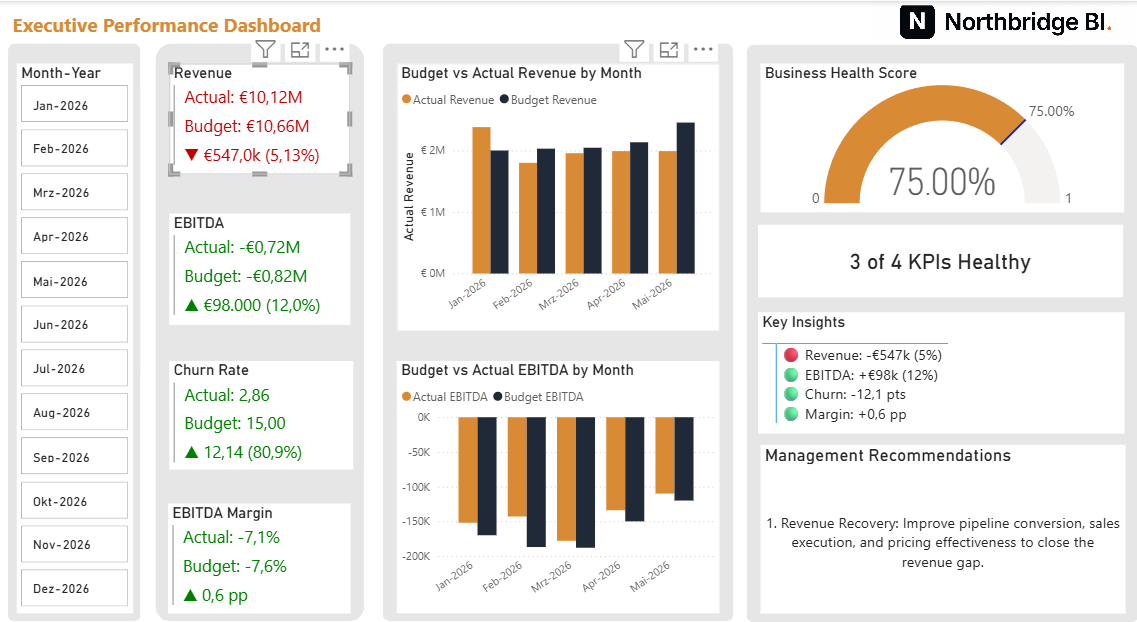
Executive Performance Dashboard
Budget vs. actual on revenue and EBITDA, churn and margin — with a traffic-light health score and ranked recommendations leadership can act on.
- Budget vs. Actual
- Health score
- Recommendations
- Variance
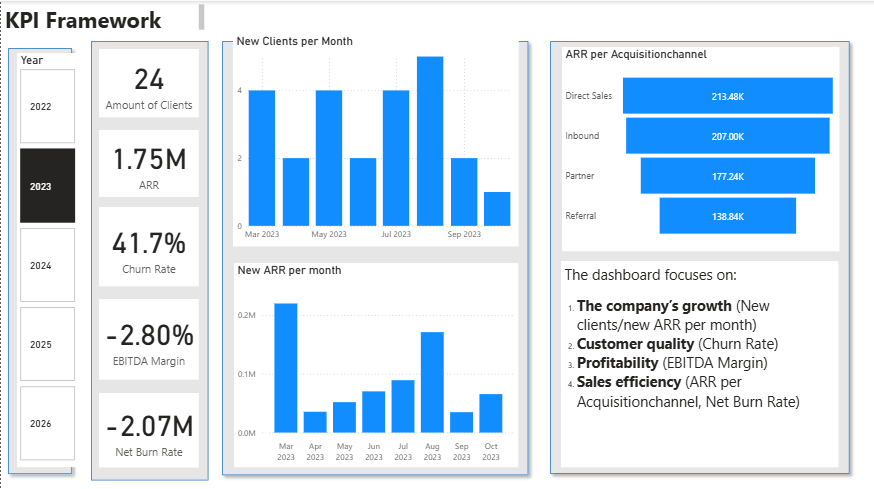
KPI Framework
One view of growth, customer quality, profitability and sales efficiency — built for monthly leadership reviews.
- ARR
- Churn
- EBITDA margin
- Net burn
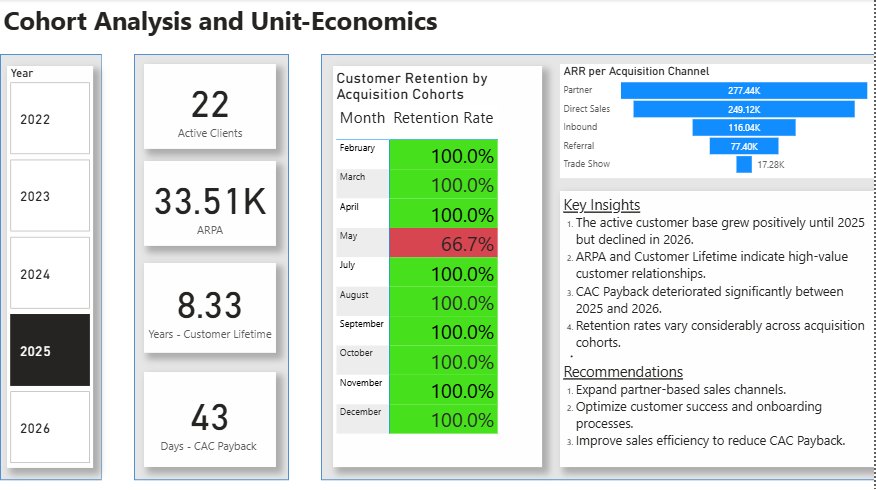
Cohort Analysis & Unit Economics
Retention by cohort, ARPA, lifetime and CAC payback — showing where the business actually compounds.
- Retention
- ARPA
- CAC payback
- LTV
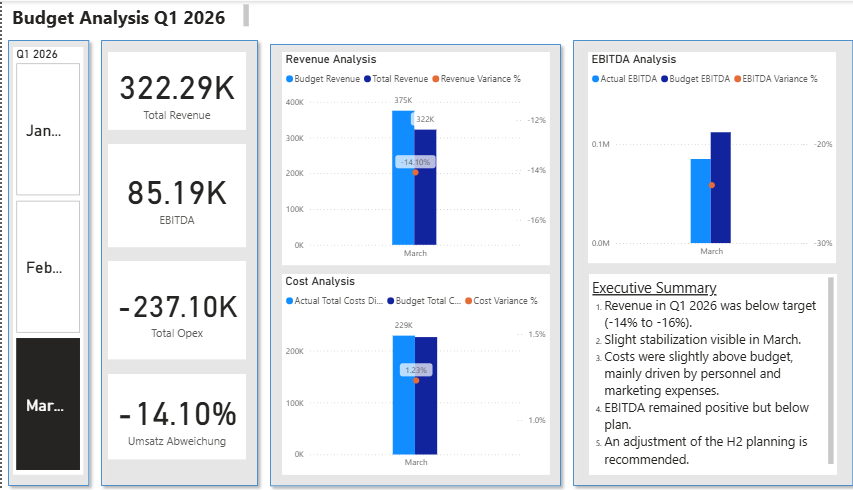
Budget vs. Actual
Quarterly P&L control with revenue, cost and EBITDA variance — plus a 30-second executive summary.
- Variance
- EBITDA
- Opex
- Commentary
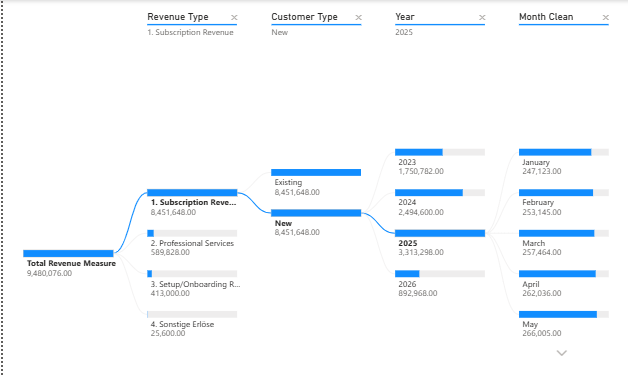
ARR Decomposition
Revenue split by stream, customer type and time — ends the “where is the growth coming from?” debate.
- Subscription
- New vs existing
- Drill-down
Sample dashboards illustrating the executive reporting delivered in this engagement. Figures shown are illustrative.
Capabilities Delivered
The capabilities delivered throughout this engagement.
- Data Strategy
- KPI Architecture
- Executive Reporting
- Revenue Reporting
- Process Optimisation
- Microsoft Fabric
Executive Briefing
Start with a 30-minute Executive Briefing. Leave with clarity on your reporting.
A focused conversation with a partner about your business, your reporting capability, and the decisions your leadership team needs to make. You'll leave with practical recommendations you can act on, whether we work together or not.
During the briefing, we'll:
- Review your reporting landscape and business priorities
- Identify the biggest opportunities to improve reporting and decision-making
- Recommend practical next steps tailored to your business
30 minutes • No preparation required • Tailored recommendations for your business